Items tagged with astronomy

NASA partook in an international exercise to test the operational readiness of limiting, or preventing, global destruction from an incoming asteroid. The exercise included 100 participants from 18 countries, including NASA scientists and...
Read more...

Skywatchers are in for a treat this month, as five planets will align in the early morning sky. In addition to the five planets, the Moon will be joining the party at the end of the month.
April provided amateur astronomers with the...
Read more...
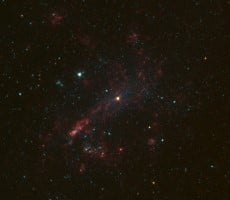
Researchers led by a team at the University of North Carolina at Chapel Hill have detected a wealth of previously unnoticed supermassive black holes in dwarf galaxies. The new information could lend valuable insight into the origin story...
Read more...
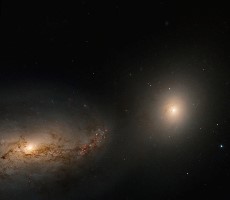
NASA's Hubble Space Telescope captured a tempestuous gravitational dance between two companion galaxies. NGC 3226 and NGC 3227, together known as Arp 94, are located somewhere between 50 and 60 million light-years away from Earth in the...
Read more...

A pair of meteor showers should provide sky watchers plenty to be excited about in the month of May. Eta Aquariids will open up the show of fireballs, with tau Herculids closing out the show at the end of the month.
Meteors entering the...
Read more...

New data suggests that post-starburst galaxies hold onto and compress large amounts of highly-concentrated, turbulent gas, but not to form stars as expected. The new data from the Atacama Large Millimeter/submillimeter Array (ALMA) shows...
Read more...

NASA believes it has solved a 60-year-old mystery pertaining to a process known as magnetic reconnection. Scientists with the space agency's Magnetospheric Multiscale Mission, or MMS, have developed a theory they believe explains how the...
Read more...

Venus and Jupiter are on what looks like a collision source in the night sky, in a rare otherworldly event. The two planets have been inching closer to one another every day this month.
If you looked up at the sky this morning, you may...
Read more...

If you have ever wanted to find your very own piece of a meteorite, now may be your chance. Astronomers are predicting that a bright fireballe that lit up the sky in Ontario may have littered the area with meteorite fragments when it...
Read more...

A quartet of planets is about to align with the Moon and you won't need a telescope to view the heavenly event. Jupiter, Venus, Mars, and Saturn will all be visible to the naked eye.
It isn't often that the alignment of so many planets...
Read more...

The mystery behind a radiant spinning whirlpool in the night sky in Hawaii on April 17th has been solved. The "night spiral" was actually created by a SpaceX Falcon 9 upper stage rocket, and not a UFO.
Footage of an eerie spinning...
Read more...

Astronomers have confirmed that some "red giant" stars in a binary system are being diminished by their voracious neighbors in a new research paper. The team of researchers from the University of Sydney says the finding is critical in...
Read more...

NASA's Hubble Space Telescope has confirmed the largest icy comet nucleus ever detected by astronomers. The comet's nucleus is larger than the state of Rhode Island, to put its size into perspective.
The gargantuan comet, C/2014 UN271...
Read more...

In two new studies, Hubble astronomers have identified freakish weather conditions on two Jupiter-sized exoplanets. On one planet it is raining vaporized rock, while on another its upper atmosphere is getting hotter rather than...
Read more...

A group of astronomers and scientists have found the most distant astronomical object ever, a galaxy far, far away. The galaxy candidate, named HD1, is 13.5 billion light-years away and is discussed in a new research paper.
A group of...
Read more...

A new discovery of high-frequency-retrograde vorticity waves in the Sun defy all explanations. The discovery indicates that vortices on the surface of the Sun move at three times the speed as previously thought.
A group of researchers...
Read more...

Astronomers have captured an image of an Odd Radio Circle (ORC) in high definition for the first time. In some instances, an ORC can have a diameter of hundreds of kiloparsecs (kps). In comparison, our Milky Way is about 30 kpc across and...
Read more...

The James Webb Space Telescope (JWST) has hit a critical milestone in its mirror alignment and NASA says it is performing at or above expectations. The highly touted space telescope captured an image last week that excited its operators...
Read more...

A pair of supermassive blackholes are locked in a fateful dance that draws them ever closer to one another. Once the pair finally merges in approximately 10,000 years, the result is expected to send out gravitational waves that will rattle...
Read more...

A new discovery reveals a unique feature when it comes to some of Saturn's aurorae. Observations made with the W. M. Keck Observatory on Maunakea, Hawaii Island, shows that some of the ringed planet's aurorae are generated by swirling...
Read more...

A dazzling image of the aptly named Spanish Dancer galaxy was captured utilizing the US Department of Energy-fabricated Dark Energy Camera. The galaxy is located around 70 million light-years away in the constellation Dorado.
Scientists...
Read more...

NASA has received the first image from its Imaging X-Ray Polarimetry Explorer (IXPE) since its launch in December of last year. The spectacular image shows the remains of a star that exploded in the 17th century, and it looks like a purple...
Read more...